

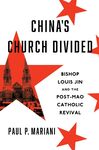
China's church divided : Bishop Louis Jin and the post-Mao Catholic revival
Role
Paul P. Mariani (Author)
Files
Description
During the Cultural Revolution, the Chinese state sought to eradicate religious life throughout the country. But by 1978, two years after the death of Mao Zedong, the Communist Party under Deng Xiaoping cautiously embraced the revival of religion. At the same time, in Rome, the newly elected Pope John Paul II made a point of renewing outreach to China. Paul P. Mariani tracks the fate of Chinese Catholicism in the wake of these transformative leadership changes, focusing on the influential Catholic community in Shanghai.
Even as Chinese Catholicism came back to life in the 1980s, the way forward was hardly an easy one. Earlier policies of the 1950s had fractured the Catholic community into a state-approved “patriotic” church that answered to the government and an underground church loyal to Rome. Even after the Cultural Revolution, Mariani shows, this divide remained firmly intact. The resulting tensions were on vivid display in Shanghai, owing to the leadership of the Jesuit priest Louis Jin Luxian. Formerly a member of the underground church, Jin realigned with the state church during the revival and was consecrated bishop of Shanghai without papal approval in 1985. Bishop Jin used his position to revitalize the local Catholic community, but his cooperation with the party put him ever at odds with underground church leaders.
Sensitive to the ideals, compromises, and disappointments of Catholics on both sides of the rift, China’s Church Divided reveals how the community navigated the irreconcilable differences between a worldwide Church centered in Rome and a regime wary of foreign spiritual authority.
ISBN
9780674297654
Publication Date
7-15-2025
Publisher
Harvard University Press
Recommended Citation
Mariani, Paul P., "China's church divided : Bishop Louis Jin and the post-Mao Catholic revival" (2025). Faculty Book Gallery. 673.
https://scholarcommons.scu.edu/faculty_books/673